Porsche 901 prototype chassis numbers: every car from 13321
- Filed by
- PorschePrototype.com Editors
- Filed
- Sources checked
- 4 listed below

This record covers
- Every documented 901 pre-production chassis number
- Nicknames, purpose and fate of each car
- Which three 901 prototypes survive
- Why a production-format number cannot be a 901 prototype
Short answerPorsche built 13 pre-production 901s between 1962 and 1964, using replacement chassis numbers that start at 13321. Seven were completed in 1963 and six in 1964. Three are known to survive: 13326 “Quickblau”, 13327 “Barbarossa” and the cabriolet 13360. Others were crashed, scrapped or are unaccounted for, and sources disagree on some details.
- Pre-production cars
- 13documented
- First number
- 13321documented
- Known survivors
- 13326, 13327, 13360documented
- 13322, 13323, 13324
- Whereaboutsunknown
Porsche’s 901 prototypes are the most documented and most misquoted cars in early 911 history. This page lists them the way a record card would: number, name, purpose, fate. Where sources disagree, both readings stay on the card.
This URL once hosted a very different page. From 2012 to 2016 it argued that a 1971 911 T was one of these prototypes. That claim is examined in the $21 million “911 T prototype” case file.
How many Porsche 901 prototypes were built?
Porsche built 13 pre-production 901s: seven in 1963 and six in 1964. All of them used replacement chassis numbers beginning at 13321. After the tenth car the numbering changed, and the last pre-production cars carried early production-style numbers.
The prototypes did different jobs. Some tested engines and carburettors, some tested bodies, heating and fuel tanks, and one was the show car that introduced the 901 to the public at the Frankfurt IAA on 12 September 1963.
Porsche 901 prototype chassis list
| Chassis | Nickname | Built | Purpose on record | Fate |
|---|---|---|---|---|
| 13321 | Sturmvogel (Petrel) | 1962 | Wind tunnel, presentations, carburettor and brake tests; first ran a four-cylinder engine | Reportedly destroyed 1965 |
| 13322 | Fledermaus (Bat) | 1963 | Reutter body; rear-seat layout, heating and exhaust tests; wore fake fins as disguise | Unknown |
| 13323 | Blaumeise (Blue Tit) | 1963 | Body by Heinz Fuchs; general development | Unknown |
| 13324 | Zitronenfalter (Brimstone) | 1963 | Engine test car | Unknown |
| 13325 | none recorded | 1963 | Karmann-built show car, Frankfurt IAA 1963, then Paris, London, Turin, Geneva | Scrapped 1965 |
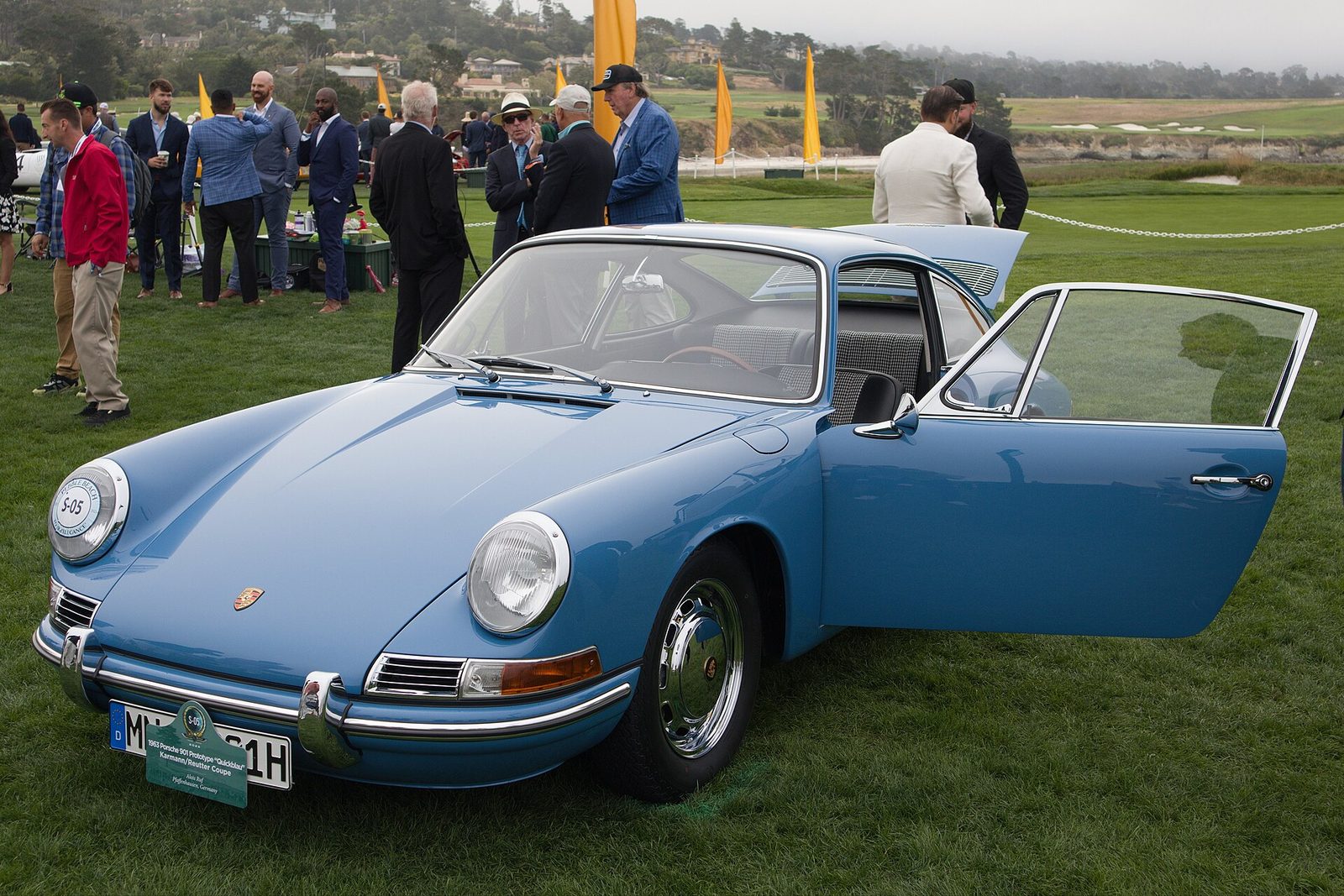
| 13326 | Quickblau | 1963 | Show car and Hockenheim test car; later owned by Ferdinand Piëch and Hans Mezger | Survives, restored by Ruf |
| 13327 | Barbarossa (Red Beard) | 1963 | Wind tunnel, forward-sliding sunroof, window and door sizes, heating and fuel tank | Survives |
| 13328 | none recorded | 1964 | Four-cylinder 902/912 development | Unknown |
| 13329 | none recorded | 1964 | Four-cylinder 902/912 development | Unknown |
| 13352 | none recorded | 1964 | Endurance testing, completed late 1964 | Unknown |
| 13360 | Cabriolet prototype | 1964 | Reinforced by Karmann; precursor of the Targa | Survives |
The sources checked for this table do not always agree. The Porsche Register records 13325 as ivory and destroyed on 7 December 1965; Excellence describes it as yellow and crash-tested in July 1965. Both agree it was scrapped in 1965.
Which 901 prototypes still exist?
Three 901 pre-production cars are known to survive, and each has a documented chain of owners.
13326 “Quickblau”
Quickblau was bodied at Karmann in August 1963 and finished by Porsche. It appeared at the Earls Court show in London and was used for testing at Hockenheim in 1964. Ferdinand Piëch owned it briefly in 1965, then engineer Hans Mezger until 1967. It later passed to bus manufacturer Walter Vetter and then to the Ruf family, where Alois Ruf Jr. began a full restoration in 2020.
13327 “Barbarossa”
Barbarossa, painted Signal Red, was the development car for the wind tunnel, a forward-sliding sunroof, door and window sizes, heating and the fuel tank. It was sold to Porsche racer and Christophorus editor Richard von Frankenburg, went to Italy after his death, and was offered for sale in the United States in 1984. Dennis Frick restored it in the 1990s for its long-time owner Don Meluzio.
13360, the cabriolet prototype
In June 1964 Porsche sent 13360 to Karmann for chassis reinforcement, a job that took about two months. It became the development car for the removable-roof Targa, shown in 1965 and put into production in 1967. It was owned in Germany by Manfred Freisinger, then by Myron Vernis in Ohio from 2001, before a sale to a UK buyer in 2014.
Why a production chassis number rules out a 901 prototype
A production-format number rules out a 901 prototype on the documented record, because every known 901 pre-production car carries a 133xx replacement number. Production 911s started at 300001 in 1964, and from 1970 the number itself encodes model year, variant and body.
That is why the claim once made on this page could be tested in seconds. The car at its centre carried chassis 9111120162. In Porsche’s 1970s format that reads as a 1971 911 T coupé bodied by Karmann, serial 0162, and its Certificate of Authenticity says the same. You can check any number with the Porsche VIN decoder, and every production format is laid out in the Porsche 911 VIN decoder guide.
The old page also borrowed real details from 13326, such as louvred quarter windows and false fins used as disguise, and matched them to features on the yellow car. Disguise panels were temporary test-mule tricks. A slant-nose conversion with louvred wings is a 1980s body style, covered in the Porsche slant nose guide.
Where do these records come from?
The main sources are Tobias Aichele’s factory-sourced research on 901 development, Jürgen Lewandowski’s 901 book, the Porsche Register, and restoration records from Ruf and Dennis Frick. Magazine research, notably Excellence, has consolidated them. None of them lists a 901 prototype under a 1970s chassis number.
Frequently asked questions
How many Porsche 901 prototypes survive?
Three 901 pre-production cars are known to survive: 13326 “Quickblau”, restored by Ruf; 13327 “Barbarossa”, restored by Dennis Frick and owned by Don Meluzio; and the cabriolet prototype 13360.
Why do 901 prototype chassis numbers start with 13?
The 901 test cars were built on replacement chassis numbers in a 133xx range rather than the production sequence, which later began at 300001. Porsche never published a reason for the 13 prefix.
Which 901 prototype was shown at Frankfurt in 1963?
The car on the Porsche stand at the Frankfurt IAA in September 1963 was chassis 13325, a Karmann-built prototype. It toured motor shows in Paris, London, Turin and Geneva before being scrapped in 1965.
Can a car with a 911 production chassis number be a 901 prototype?
Not on the documented record. Every known 901 pre-production car carries a 133xx replacement number. A car stamped with a later production number, such as a 1971 911 T, would need factory documentation showing it was built from a prototype shell.