Factory Porsche slant nose vs conversion: how to tell them apart
- Filed by
- PorschePrototype.com Editors
- Filed
- Sources checked
- 4 listed below
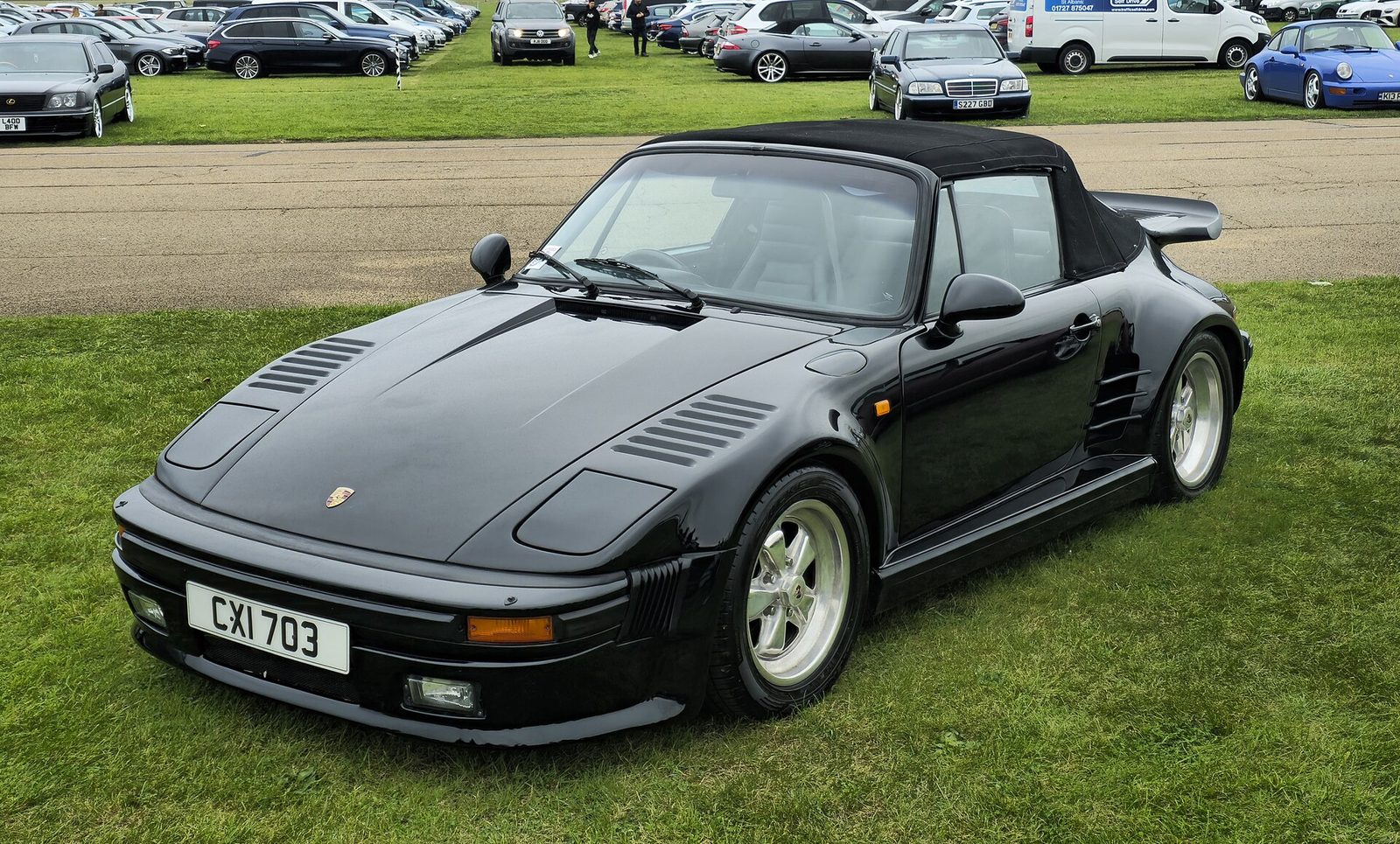

This record covers
- Why slant-nose verification is harder than it looks
- Checks for 1987–1989 M505 and M506 cars
- Checks for 1981–1986 Sonderwunsch cars
- Physical clues specialists look at
Short answerFor a 1987–1989 slant nose, look for option code M505 (US) or M506 (rest of world) on the option sticker and the factory record. For 1981–1986 cars the chassis number cannot tell you, and the Kardex or Certificate of Authenticity often shows nothing, because Sonderwunsch conversions were invoiced as workshop orders. Those cars need original invoices, correspondence and specialist inspection. Any slant nose on a non-Turbo or pre-1975 911 is a conversion unless factory documents prove otherwise.
- 1987–89 proof
- M505 / M506 on build recorddocumented
- 1981–86 on Kardex
- Often absentdocumented
- VIN shows slant nose
- Neverdocumented
- Single central headlight motor on factory cars
- Specialist rule of thumbclaimed
Slant-nose kits were sold for decades, and good ones are hard to spot from the outside. The factory made the job harder by keeping incomplete records of its earliest cars. This page is the checklist, in the order that saves time.
Why is a factory slant nose hard to verify?
A factory slant nose is hard to verify because the evidence changes with the year. From 1987 the slant nose was a coded option. Before that it was a special request handled by the Sonderwunsch department and billed like a workshop job, so the factory record often says nothing about it.
How do you verify a 1987–1989 slant nose?
You verify a 1987–1989 slant nose by finding M505 or M506 on the factory record.
- Decode the VIN on the Porsche VIN decoder and confirm a 930 Turbo of the right year; the 17-digit VIN decoder guide shows where the type code sits.
- Check the option sticker in the service booklet and under the front lid for M505 (US) or M506 (rest of world).
- Order a Porsche Production Specification, since stickers can be replaced. See the Certificate of Authenticity guide.
- Check the specification fits the code, including the oil cooler arrangement that differed between M505 and M506.
How do you verify a 1981–1986 slant nose?
You verify a 1981–1986 slant nose with documents from outside the factory record, because the chassis number cannot tell you and the Kardex often omits the work.
- Original invoice from Porsche’s Zuffenhausen workshop or the ordering dealer
- Correspondence between dealer, importer and factory about the conversion
- Service booklet entries and early ownership records showing the slant nose from new
- Period photographs of the car with its slant nose
- Specialist inspection of how the wings, headlight mounts and inner structure were made
A car without any of these may still be genuine, but it cannot be sold as proven.
What physical clues do specialists check?
Specialists check construction details, while treating each as a clue rather than proof:
| Area | What specialists look at | Status |
|---|---|---|
| Headlight mechanism | Factory cars are reported to use a single central motor with rods to both pop-ups; many conversions use one motor per lamp | Specialist rule of thumb |
| Wings | Quality of the reshaped steel, seams and louvres | Needs expert eye |
| Front apron and oil cooler | Arrangement consistent with the car’s market and code | Checkable against code |
| Base car | A 930 Turbo of a year when factory slant noses were built | Checkable by VIN |
What if the car is not a Turbo?
If the car is not a Turbo, treat it as a conversion. The production slant nose was a 930 feature. A slant nose on a 1960s or 1970s narrow-body 911 is almost certainly a later conversion unless factory documents show otherwise. That is exactly the situation in the $21 million “911 T prototype” case file, where a 1971 911T wore slant-nose bodywork.
Is a conversion a bad car?
A conversion is not a bad car. Many were built by respected shops and are enjoyable and valuable in their own right. The problem is only a conversion described as factory. The generations and production numbers behind that distinction are on the Porsche slant nose page.
Frequently asked questions
Can a VIN show a factory slant nose?
No. No Porsche VIN or chassis number encodes the slant nose. For 1987–1989 cars the option codes M505 or M506 on the factory record are the evidence; earlier cars need other documents.
Why is my 1985 slant nose not on the Kardex?
Before 1987 the Sonderwunsch department carried out slant-nose work as a workshop order invoiced separately, so it was often not entered on the Kardex or later Certificate of Authenticity. Look for the original invoice, dealer correspondence and specialist inspection.
Is a slant nose conversion worth less?
Usually, yes. A conversion is valued as the underlying car plus the quality of the work, while a documented factory slant nose commands a premium for its rarity.
Were there factory slant noses on non-Turbo 911s?
The production slant nose was a 930 Turbo feature. Individual Sonderwunsch cars on other bases may exist, but a non-Turbo slant nose should be treated as a conversion unless factory documents show otherwise.